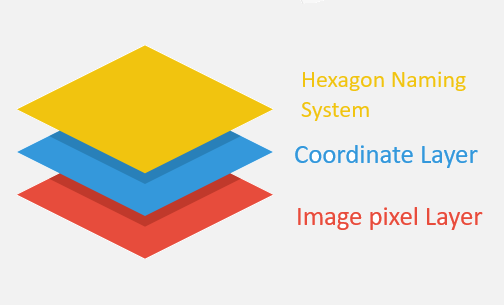
The Battlefield map has 3 layers.
The top layer is a canvas layer for drawing text, points, lines and polygons.
Click here to draw polygons on a hexagon map
Click here to draw polygons on a pointy hexagon map
The middle layer is a Hexagon Grid wargame calculator.
- The HexagonGrid uses mouse coordinates to identify points, lines, hexagons and polygons. GIS (Geographic Information System)
Analytic geometry calculations use the HexagonGrid cartesian coordinate system. Unit placement, range, zone of control, line of sight and lines of communications are examples of using geometry for analyis.
The HexagonGrid wargame calculator can update information on the visible canvas. It can calculate the hexagon name for display. It can identify terrain data and display it on the screen as the mouse moves. It can update the canvas to draw hexagons. How to draw a hexagon map using the cartesian coordinate system.
The bottom layer is a map image file.
As the mouse moves, it records x,y screen coordinates. This information is sent to the HexagonGrid wargame calculator. The following points are recorded.
- hexagon point
- hexside point
- hexside edge point
- corner vertex point
- polygon coordinates
Hexagons are used for unit placement. Staging areas and elimination trays show up as rectangles and circles on the map. Terrain features are located inside a hexagon or near the hexside on the map.
Geocoding
Geocoding is the process of converting human-readable addresses and place names into geographic coordinates (latitude and longitude). Hexagons on the hexagon grid have location names. All of these elements need to be converted to a reference geographic coordinate.
Reverse Geocoding
The reverse of this geocoding process is reverse geocoding, which converts grid coordinates into a readable address. Hexagons are give a location name. e.g. 0201 or G-4
For example, when a mouse over event occurs on the map below at hexagon 0201, the second layer identifies the hexagon with a center at (90,80) pixels. The second layer calculates the (12,20) grid coordinate. The third layer reverse geocodes a grid name of 0201.Grid Naming Systems - reverse geocoding hexagons
Two examples - Standard 0101 & Blitzkrieg
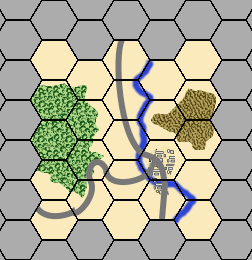
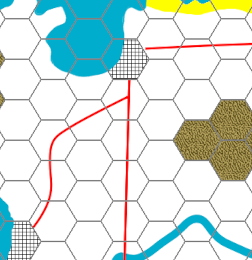
Other Examples of hexagon naming systems
- flat 0101: Battle For Moscow
Click to read Avalon Hill experimental coordinate systems.
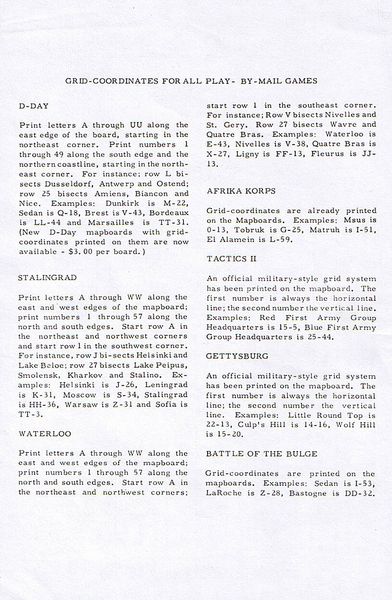
- flat A01(240°): 1914
- flat A-01(240°): Blitzkrieg
- flat A-01(240°): D-Day
- flat A-01(300°) Battle Of The Bulge
- flat A01(60°): Stalingrad
- pointy A-01(240°): Africa Korps
- pointy A01(240°): Waterloo