Military Force
On War
Carl von Clausewitz
The Law of Numbers
If we ... strip the engagement of all the variables arising from its purpose and circumstances, and disregard the fighting value of the troops involved (which is a given quantity), we are left with the bare concept of the engagement, a shapeless battle in which the only distinguishing factor is the number of troops on either side.
These numbers, therefore, will determine victory. It is, of course, evident from the mass of abstractions I have made to reach this point that the superiority of numbers in an engagement is only one of the factors that determine victory. Superior numbers, far from contributing everything, or even a supstantial part, to victory, may actually be contributing very little, depending on the circumstances.
In this sense superiority of numbers admittedly is the most important factor in the outcome of an engagement so long as it is great enough to counterbalance all other contributing circumstances. It thus follows that as many troops as possible should be brough into the engagement at the decisive point.
A comprehensive theory of combat based upon a comparison of the relative numerical combat powers of two opponents, in which combat power for each was calclated as follows:
P = N x Q x V
N represents the number of troops in a military force. Q is the quantifed value for the fighting quality of the troops. V is the variable factors reflecting the combat circumstances affecting the force. The variable factors include environmental, operational and behavioral factors.
Unit Data
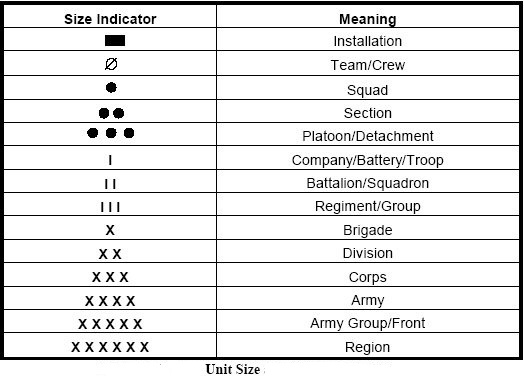
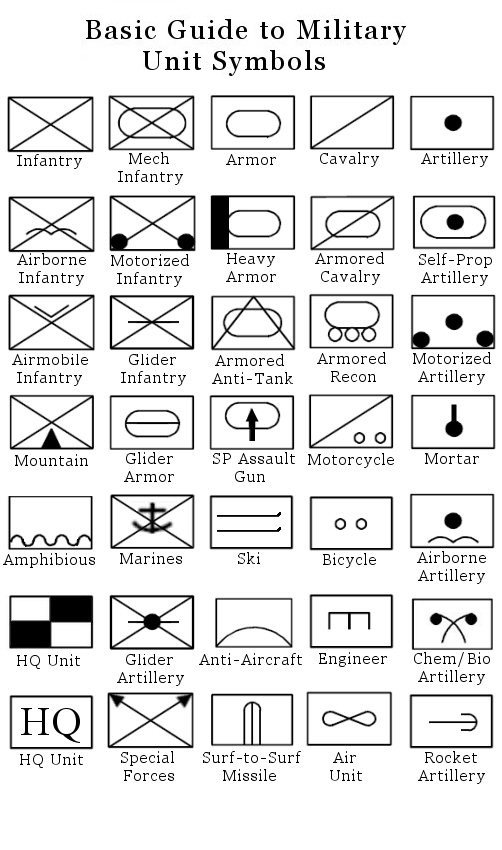
The playing pieces represent military units with the values of its unit size (N) and unit strength Q and unit mobility range (V) printed on it. Other operational and behavioral variables V such as fatigue, morale, leadership, training and experience are recorded for each military unit.
Unit Size
Unit Types
Color coding wargame players from Wargaming Handbook UK Ministry of Defense
- blue - friendly or allied forces
- red - the opposing force
- orange - armed non-state forces
- black - organized and transnational organised criminals
- green - indigenous security forces
- brown - neutral actors or civilian population
- white - political organisations, diplomats, humanitarians and non-governmental organisations